

Why fall in love with specialty coffee from Peru

When quality is assessed at the highest level: Cup of Excellence Peru
In November 2025, Charles was part of the international jury for the Cup of Excellence Peru, where he had the opportunity to evaluate the best microlots from across the country and observe the development of Peruvian specialty coffee firsthand.
Cup of Excellence is not just a "competition." It is a rigorous and transparent process where coffees are repeatedly cupped, evaluated, and compared across the jury. And what's beautiful about it is that when a coffee succeeds, it often truly changes the farmer's life – they receive fairer recognition, visibility, and new opportunities.
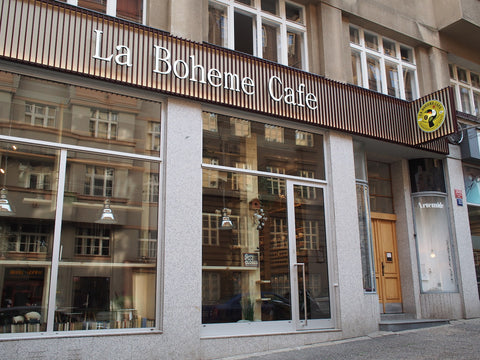
For us at La Bohème, it is also a powerful reminder of why we do this work:
so that a cup isn't just good – but also has meaning beyond it.


Peruvian coffee is primarily grown on the eastern slopes of the Andes, at altitudes between 1,200 and 2,200 meters. The high altitude slows down the ripening of coffee cherries, which leads to greater complexity and more pronounced, yet still delicate, acidity.
Typical characteristics of Peruvian specialty coffee:
- clean and transparent flavor profile
- fresh, but not aggressive acidity
- light to medium body
- natural sweetness
- high legibility of individual notes
In the cup, citrus, stone fruit, apple, honey, caramel, or delicate chocolate often appear. Some lots may also have a floral or slightly mineral character

Where is specialty coffee grown in Peru
A large portion of specialty coffee production in Peru comes from small family micro-farms. Here, coffee is grown on steep slopes, often in the shade of trees, which promotes biodiversity and slower fruit ripening. Harvesting is done by hand, and farmers select only ripe cherries.
The most common processing method is washed, which promotes flavor clarity and a clean cup structure. Thanks to careful processing directly within the communities, consistent and balanced batches are produced that well represent the terroir of individual regions.

How coffee is grown in Peru (and why it's so challenging)
Most Peruvian coffee comes from small family farms. Micro-farms often cultivate on steep slopes, where harvesting and transportation are logistically challenging.
Specifics of cultivation:
- Steep slopes and difficult accessibility - harvesting and transportation are a logistical challenge.
- Variable microclimate - fog, rain, sun, wind… sometimes all in one day.
- Shade-grown cultivation - coffee often grows under trees, which promotes biodiversity and slower ripening, but also places higher demands on farm management.
- Manual selective harvesting - quality Peruvian coffee is often harvested by ripe cherries, which is laborious but crucial for taste.

Coffee here is grown almost exclusively on small family farms, often on slopes so steep that one would expect mountain goats rather than coffee trees. Life here flows slowly: narrow roads, simple houses, and drying beds full of beans that turn into future cups in the sun.
For local families, coffee is not just a crop – it is an anchor and security, the main source of income and a reason to stay on the land that has been cultivated for generations. Stable and fair prices for quality coffee here mean more than just trade: they mean school for children, healthcare, home repairs, and the opportunity to invest in better processing.


Comentarii (0)
Nu există comentarii la acest articol. Fii primul care lasă un mesaj!